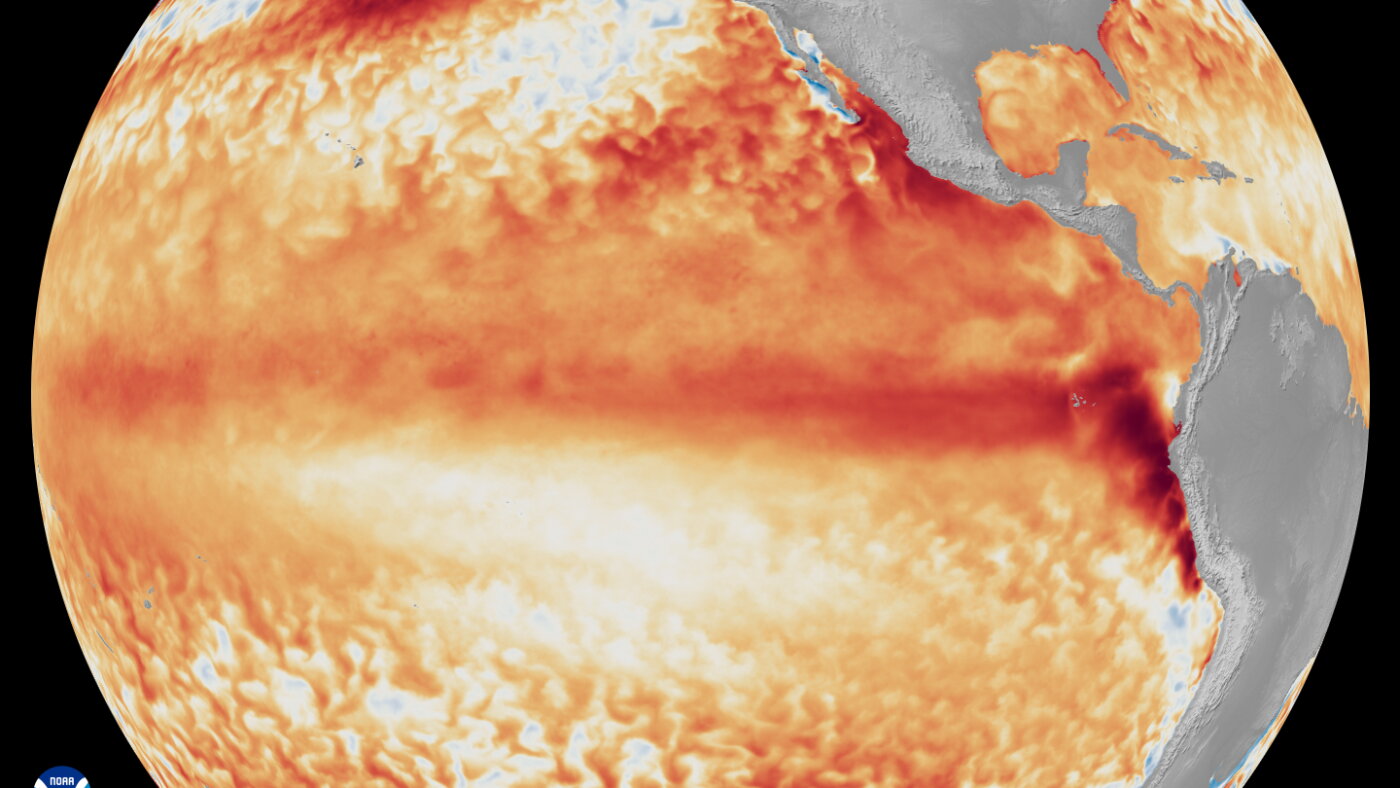


In June 2026, Pacific Ocean sea surface temperatures around the equator were already abnormally warm, an indicator of a developing El Niño. Since then, they’ve only increased.
NOAA Satellites
hide caption
NOAA Satellites
Federal forecasters say this year the planet could see the strongest El Niño event on record. It’s already being called “Super El Niño” and even “Godzilla El Niño.” El Niño is a natural climate pattern that has far-reaching impacts across the planet, potentially affecting hundreds of millions of people.
Where those impacts happen can vary drastically from one El Niño to the next. Here are the basics of what this historic event could bring.
What is El Niño?
El Niño occurs every two to seven years. It develops when a vast amount of water in the eastern Pacific Ocean warms up around the equator. That water releases massive heat, redistributing warmth from the ocean to the atmosphere. That shifts weather patterns around the world.
The flip side of El Niño is a La Niña, which is marked by relatively cool water in the tropical Pacific around the equator. These events are responsible for some of the biggest weather variability the planet experiences.
El Niño is like dropping a rock in a pond, says Daniel Vimont, professor of atmospheric and oceanic sciences at the University of Wisconsin-Madison. “Even though you’re not where the rock hit, you still may feel the effects of those waves,” he says. “El Niño is the same thing, except it’s an enormous rock in our entire Earth’s system, and we feel the response.”
How strong is it?
Sure, “Godzilla El Niño” is catchy, but technically, NOAA forecasters say this year’s El Niño will fall into the “very strong” category. It’s measured by the temperature of the ocean in a particular region off South America. The warmer the water, the stronger the El Niño. When that water is more than 2 degrees Celsius warmer than average, it qualifies as a “very strong” El Niño.
The last strong events were in 2015-16, 1997-8 and 1982-83. El Niños typically peak in November and December, but already, this El Niño is the strongest ever measured for this time of year. NOAA forecasters expect it to last through early 2027.
What will the impacts be globally?
All that added heat in the atmosphere raises temperatures globally. El Niño years tend to be the hottest on record. Forecasters say this year may get close to taking the top spot, but it’s very likely that temperature records could fall in 2027. The planet is already warmer due to climate change, because emissions from burning fossil fuels are trapping more heat in the atmosphere.
El Niño also shifts rainfall patterns globally, raising the chances for destructive flooding in some parts of the world. Other regions get drier, exacerbating droughts. Both impacts can be catastrophic to agriculture around the world. The United Nations World Food Programme estimates that El Niño could push at least 49 million more people into acute food insecurity by the end of 2027.
What will the impacts be in the U.S.?
In El Niño years, the southern U.S. tends to see more intense rainfall because the jet stream shifts to the south. That raises the risk of floods along rivers and in cities. Still, in the Southwest, more rain could alleviate drought and recharge underground aquifers.
“El Niño tends to juice up those storms so that you get more really strong rain events,” says Martin Hoerling, meteorologist and adjunct lecturer at the University of Colorado Boulder. “So if you were running a deficit in your water supply, a big El Niño, especially like the one we’re having, can really get you into recovery mode that otherwise might have taken you years.”
The northern half of the country gets warmer and drier, something that could exacerbate the current drought in the Intermountain West. Some states experience mixed effects during El Niños, like California. The state saw historic flooding in the 1997-98 El Niño, but was drier than average during the 2015-16 one. Climate experts say the current El Niño is so strong, it’s more likely California will experience extreme rain.
El Niños can also lead to fewer hurricanes in the Atlantic Ocean, since it’s more difficult for the storms to form. In the Pacific Ocean, hurricanes can get more frequent, fueled by warmer ocean water. Already this year, hurricanes have intensified rapidly in the Pacific, and Hawaii has had close calls with several hurricanes that brought destructive rain and wind.
Can we blame it all on El Niño?
Certain weather changes are common during El Niños, but there are no guarantees that extreme weather events this winter will match those predictions for every region.
“El Niño is like loading the dice,” Vimont says. “While we’re loading the dice for a certain type of response from El Niño, we still know that in any given year, there are still natural fluctuations that may mask that or cause the response to be slightly different than what we might expect.”
In addition to that natural variability, weather events are also being affected by climate change. The most intense storms are already producing more rainfall in most of the U.S., since a warmer atmosphere can hold more water vapor. Heat waves and droughts are also getting more intense due to rising temperatures. Climate experts say El Niño and climate change impacts will both play out this winter, but while El Niño will fade, the effects of climate change will continue.


